Dribble Around Cone & Pass Relay Race ™
No Lines Soccer Drill
that is a Practice Game
(Use this game to teach: Players to play faster, show that teams who play faster will win, how to Play Fast, Aggressive Receiving, One-Touch as a way to play faster, to pass ASAP instead of holding the ball too long, passing while running, speed dribbling, turning, importance of "first-touch", how to receive hard and soft passes; and receivers to anticipate the pass, to be alert, to move to the ball, and that the receiver must be alert for and stop bad passes if possible. U8 and older)
Save $5 on SoccerHelp Premium - SoccerHelp Premium has 1,500 pages & 5,000 links for easy navigation. You can use the Coupon 5offpremium to subscribe to Premium for $10 for 30 days, $20 for 120 days, or $35 for a year. We do NOT automatically renew subscriptions. 15,000 Coaches have subscribed. 5-day money back guarantee. 400 Testimonials Sign up at http://soccerhelp.com/members/signup
"We played Dribble Across a Square and Dribble Around the Cone and Pass Relay Race at every practice, and the results were phenomenal." Coach Greg, U-9 Coach and Premium Member, USA
"Thanks to the Dribble Around Cone and Pass game, I must have yelled beautiful pass more yesterday than I did in the first three games." Coach Mark, U10, CA, Premium Member
"We do the "Dribble Around a Cone & Pass Relay Race" every practice and it's a huge help in teaching awareness that both the passer and receiver have a responsibility on a pass." Coach Nick, U-14 Coach and Premium Member
"Dribble Around Cone and Pass is one of my fundamental drills. I teach it to my new teams in the first week of practice and we do it at least every third practice. I run it as a series of races, with the 1st, 2nd and 3rd place teams getting points over a series of 5 races. We keep totals of the points and determine a team champion for the day. It is a GREAT drill." David, Hawaii, select team coach
""I consistently use the Dribble Across a Square and the Dribble Around a Cone and Pass drills. They have done wonders for my team. We played the top team in the league who were undefeated and beat them 7-1. It was heaven to say the least." Chris, TX
"At every practice we religiously do Dribble Across a Square, Dribble Around A Cone and Pass, etc, etc, - the poise my boys have on the ball is leaps and bounds above other teams now. Before, we were 4 wins 5 losses (19 Goals scored and gave up 25 Goals). Last season our record was 9 Wins 1 Tie (60 Goals scored and gave up 5 Goals)." Coach T, U12 Boys travel team, MA, Premium subscriber
Use this game to teach your players to play faster - it teaches how to play fast and that the team that plays faster wins. You will see fast results and set-up is easy. It teaches ways of playing that will make a HUGE difference - Aggressive Receiving, to Pass ASAP instead of holding the ball too long, and One-Touch Play will greatly help your attack. To get the best results, use the "Tips" Method described below.
Summary:
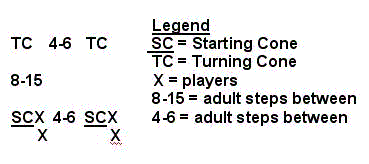
Divide into teams with 2 players per team. (It's okay if one of the teams has an extra player, or a parent can play). Players race around a "Turning Cone" that is about 6 to 15 steps from the "Starting Cone" and the dribbler can pass to the waiting teammate as soon as the he goes around the "Turning Cone". One point for each completed pass. This is a good game to play right after "Dribble Across A Square", because you can use the cones that are already on the ground.
Teaches:
Speed dribbling (aka "Running With The Ball"), turning, passing and receiving at "Game Speed" and while under pressure. It also teaches the Passer how to kick the ball while running and under pressure, to pass quickly after having made a turn, and that the Passer should quickly move after making a pass (and not stand still, so it helps teach the concept of "Movement Off The Ball", as opposed to making a pass and just standing there). It also teaches Receivers that they must anticipate the pass and be alert and move to the ball, instead of waiting for the ball to come straight to their feet (this is a common mistake young players make - they wait for the ball to come to them, instead of going to the ball - in this Practice Game they will learn to watch for the pass and anticipate it's direction and move to the ball - if they don't, they will lose the game, because there will be bad passes and the receivers that stop those bad passes or run to the weak passes will win the game). You can also teach Receivers to come to slow or short passes (so they get to the ball quickly), and to one-touch block the pass in front of them as a way to go faster. The game also teaches the Passer that proper "weight" of the pass is very important (the pass can't be too hard or too slow). It can also be used to teach the receiver one-touch control, playing the pass into open space, and a quick first step into open space (as opposed to "2-touching" the ball and giving opponents time to close in). This one-touch style of play should greatly help your attack and your players will get used to one-touch and see the advantages. If they don't learn to one-touch,they will lose this game. They will also learn when to one-touch and to only 2-touch when they can't one-touch. This is a SoccerHelp.com practice game that is a drill.
Set-up:
The Set-up and the video that Demonstrates this drill that is a Practice Game are now on SoccerHelp Premium.
Save $5 on SoccerHelp Premium. This free site has 300 pages. SoccerHelp Premium has 1,500 pages, including 200 pages about Formations. You can use the Coupon 5offpremium to subscribe to Premium for $10 for 30 days, $20 for 120 days, or $35 for a year. We do NOT automatically renew subscriptions. 15,000 Coaches have subscribed. Sign up at http://soccerhelp.com/members/signup. Read about SoccerHelp Premium
The Game:
- Start by lining each team up beside the Right Side of their Starting Cone, so all the teams are turning in the same direction (to the left).
- This is now on SoccerHelp Premium.
- This is now on SoccerHelp Premium.
- This is now on SoccerHelp Premium.
- If a team makes an inaccurate pass, the receiver must run after the ball and doesn't get a point until he or she controls the ball. One really bad pass can cause a team to lose the game.
- After each game, have the teams start beside the Left Side of the Starting Cones, so in the 2nd game they are turning to the right.
- First to 6 wins that game - play the game 5 or 6 times at each practice. (This is an intense game. Another reason to only play to 6 is that if one team makes a really bad pass, they will probably not be able to catch up. I think it's better to play to 6 five or six times. You want to give tips after each game, so short games are best because you can give a tip after each game that your players can try and they will learn faster).
- Teams get one point for each completed pass (define a completed pass as when the receiver controls the ball).
Scoring:
First team to 6 wins that game - play the game 5 or 6 times at each practice. (READ THIS: It is better to play this game 5 or 6 times by only playing to 6 than it is to only play it 2 or 3 times to ten. The reason is that you want to give a tip after each game, so short games are best because you can give a tip after each game that your players can try in the next game and they will learn faster. Remember, the objective is for your players to improve at a fast rate - the games are a way to keep it fun and create competition and pressure to play fast, and a way to measure progress. With Rec teams, rather than "balancing" Teams, I suggest pairing up your best players to play together, so they get used to playing together and can push each other. I suggest having the Best "Teams" compete against each other while the Weaker Teams watch, and then have the Weaker Teams play against each other while the Better Teams watch. I think that is better than trying to mix up good and weak players on the same team and better than having a Weak Team compete against a Strong Team. Watching a short game will let the players get a breather. KEEP IT MOVING FAST so they get a good workout.
Note:
The passing part of this may be too hard for U-6. If so, just have them dribble around the Turning Cone back to their teammate who then takes the ball.
Things Your Players Can Learn by Playing This Game:
- Teamwork, Responsibility and the Benefits of Listening to the Coach and Doing the "Right" Things (the things the Coach tells them to do). This Game will teach your players that teamwork is critical. The Passer and Receiver must BOTH do their jobs and work together or they will lose. One bad mistake and they lose. The teams that hustle, are most alert, try the hardest and listen to the Coach's tips will do the best and win the most - those that don't will lose. Players will get quick, positive feedback if they are doing the right things and will quickly see the negative results of NOT doing the right things - they will have to do the "right" things if they want to win, and if they don't, they will lose. I think most coaches want their players to want to win and to want to try to do the "right" things. In this Game, players immediately see the results of listening to the Coach and doing the "right" things that he tells them to do. If they listen to the Coach they will win... if they don't, they will lose, and it will be clear why they lost. It's a very good way to teach many important things.
- Kicking and Passing the Ball While Running. I don't have to explain why this is important. A basic and very important skill is to be able to kick the ball accurately while running, and the only way to learn that is by practice. Many coaches spend time on "Shooting Drills". I think this Game is a better, more efficient way to practice this skill. Also, this Game teaches players to perform the skill while under pressure and at game speed. If you practice a "Shooting Drill", how many actual shots will each player get? 3 to 5? You can play this Game with pairs (2 players per team), and in 3 games each player will have gotten about 15 shots (i.e., 15 practices on kicking a ball while running and under pressure at game speed). You can play 3 games in about 10-15 minutes. Think about it. The players are getting 300% to 500% more practices of this skill and the practices are under pressure and at game speed, and the players are having fun.
- Improving the Receiver's First-Touch and One-Touch Control to Open Space. Want to make your attack faster and more creative? One of the best ways is by teaching your players to play faster and to use "open space". In this Practice Game, a player can either receive the ball "2-touch" (i.e., stop the ball and THEN start to dribble). OR he can One-Touch block the ball into the open space in front and run to the ball, which will speed up his play. One-Touch Play is a concept and style of play that you want your players to learn because it's faster and teaches them to think about how to use "open space" to advance their attack. When you play the Practice Game, the teams with receivers who One-Touch the ball will beat those who don't. The result will be that all your players will quickly and clearly see the advantages of One-Touch Play and want to learn to play this way. They will be motivated to learn to play One-Touch so they can win the game by playing faster. To be successful at "one-touch", they will have to have a good "first-touch", so they their First-Touch will improve too. This will change the way your players think about playing and that is HUGELY important. One Touch is simply a better way to play. This is the start of teaching them One-Touch Passing.
- Receiver to Stay on Toes and Stop Bad Passes. As described above, you MUST teach your player's to NOT expect a pass to come to their feet. They MUST stay on their toes and ready to move in either direction. Their TOP PRIORITY MUST BE to stop a pass from going past them, because if that happens the opponent will get the ball. In this game, if a bad pass goes past the Receiver, his team WILL LOSE THE GAME.
- Receiver Should Move to Ball (Not Wait for Ball to Come to Feet). In addition to stopping a bad pass, this Game will teach the receiver to MOVE TO THE PASS. The rules of this Game allow the receiver to move toward the pass as soon as the ball is passed. Now, the receiver will learn that he can't just rush at the ball because if the pass isn't accurate it will go past him, and one bad pass that isn't stopped will lose the Game. So, the Coach should advise players to watch to be sure the pass is coming toward them before starting their run toward the pass - they should get in line with the pass. The way to do this is move to intercept the ball - that is the first thing to do. Teaching players to move to the pass has many advantages. You may be thinking "There are times when the receiver shouldn't move toward the pass". Yes, that's true, but your players will figure it out. Moving toward the pass will prevent the pass from being intercepted by an marking opponent. It also teaches the receiver to watch the ball's 'line" and to NOT wait for the ball to come to his feet. It teaches movement and aggressive play, which are both good things, and that the receiver shouldn't wait for the pass to come to his feet. The teams that move to the ball best will usually win this game. Your players will quickly and clearly see the advantages and want to learn to play this way. They will be motivated to learn so they can win the game.
- Accuracy and Proper Weight on Passes in Game Conditions. This Game teaches players to make accurate passes that have the proper "weight". The pass must be toward the receiver because one bad pass that the receiver can't stop will lose the Game. It also teaches the importance of the proper "weight" on the pass - the pass shouldn't be too hard, or the receiver won't be able to control it. But is shouldn't be too soft either. Players will learn this by playing the Game, and it's the role of the Coach to give "Tips" that will help them play better.
- Speed Dribbling: Show players how they can go faster by "Speed Dribbling" from the start. The first player can go faster if he kicks the ball in front of him and runs to it - this is called "Speed Dribbling". Notice that he can't kick it too far or he will go far past the turning cone and that will slow him down. He will learn about how far to kick it so he can catch it just before the turning cone and make the turn. After the first player, each subsequent player will start as a "receiver" and can block the pass forward as a way to go faster, but they can't block it too far or they will have to chase it farther than necessary. They will learn by playing the Game, with the Coach giving them Tips for how to go faster.
- Observation as a Teaching Tool. It might be a good idea to let your players watch the best 2 pairs play this game and point out what they do right and wrong. The game can be played to 10 in a few minutes. You can point out why one team wins and the things they do that are right and wrong.
- Why This Game Will Help Your Scoring - Aggressive Receiving and One-Touch Play will help your players score more goals. Think about it - what you want your attackers to do is to read the "line" of the ball and move to it or adjust their position (that will help greatly with rebounding) AND one-touch play is CRITICAL inside the Penalty Box. If you can teach your attackers Aggressive Receiving and One-Touch Play you will start to score more goals.
- Passing as Soon as There is an Opportunity and Passing Under Pressure - Coach Jeff wrote - "One problem I am having is the first thing the boys want to do is dribble instead of passing the ball up field or out to the wings...any practice games you could suggest? They want to dribble first, then 2 and sometimes 3 defenders converge and then it makes it difficult for them to get rid of the ball." This game teaches passing under pressure AND can be used to teach the ADVANTAGE of passing as soon as possible. If you want to teach those things, tell your players: "In this game, the players who pass the ball as soon as they can after they go around the cone will play faster and their team will win IF they are able to make decent passes AND if the receiver is an Aggressive Receiver and One-Touches the ball in front to play faster."
Teach Your Players to Play Fast:
12 ways Dribble Around Cone & Pass Relay Race teaches players to play fast. If you teach your players to do the 11 things below, it will HUGELY help them. The team that plays faster will usually win. This is true for all teams - Rec, Travel and High School. Use Dribble Around Cone & Pass Relay Race to teach your players:
- One-Touch as a way to play faster and to think about how to use Open Space to advance the attack.
- To pass ASAP instead of holding the ball too long - If an attacker holds the ball too long, it gives opponents time to recover and the opportunity is lost. In addition, defenders will shut down the dribbler and take away passing options.
- Aggressive Receiving - Receivers should be taught to expect a Bad pass instead of expecting a good pass. Receivers MUST stay on toes, judge the direction of the pass and stop bad passes. If the pass is to the receiver, the Receiver should move to ball and NOT wait for ball to come to his or her feet).
- Receivers Should Move to the Pass Instead of Waiting for the Ball to Come to Their Feet - As soon as the pass is made, the Receiver should judge if it is going straight, left or right and, if possible, move toward the pass instead of waiting for the ball. The rules of this game allow the Receiver to move toward the pass as soon as the pass is made. Obviously, the Receiver must first judge if the ball is going straight, left or right. Moving to the pass allows faster play and in real games will also decrease the number of intercepted passes. Use this as a Tip and a Teaching Point - the teams that move to passes will win more than those that don't, so if players want to win these games, they must learn to move toward the pass so they can play faster.
- Passing while running (this will also help them learn how to shoot accurately while running).
- Turning while dribbling fast, which involves controlled deceleration.
- Importance of "first-touch" when receiving a pass.
- Speed dribbling while keeping the ball under control.
- Accuracy and proper weight on passes while playing fast and under pressure (like players must be able to do in real matches).
- To only 2-touch if you can't one-touch - One-touch is a faster way to play. I'm not talking about using this game to teach one-touch passing, I'm talking about teaching players to one-touch the ball into open space and running onto it when that is possible. That will start to teach them how to use Open Space to their advantage so they can play faster.
- Alternate the Directions they Turn so they Practice Turning Left and Right - Play to 6 and then switch the direction they turn around the cone so they are turning left one time and right the next time, etc. That will teach them to turn fast in both directions.
- Play Each Game to 6 and Give a Tip After Each Game About How to Play Faster - After each game give ONE tip about how your players can play faster (giving one tip at a time lets your players try that tip and they can see that your tips work). You can point out what the team that won that game did to win (they either played faster or made fewer mistakes). Continue to point out the ways that your players can play faster and so they can win the practice games they play of Dribble Around Cone & Pass Relay Race.
Teach By Giving Tips:
This is easier than you think: Let's say you're playing "Dribble Around Cone & Pass Relay Race". Play it once and ask "Who wants to win this game?" Tell them you will give them a tip that will help them win. Here's an example of a tip: Tell them that the player who starts with the ball can kick the ball in front and run to it as a way to go faster. Tell them they will just have to be sure to not kick it too hard. (Demonstrate or have a player demonstrate). Another tip: Pass the ball as soon as you can after you have rounded the cone. Another tip: The Receiver must stay on his toes and watch for whether the pass is going to his left or right and start to immediately move that way - the Receiver's most important job is to STOP the pass, because if one pass gets by him his team will lose the game (this will start to teach Receiver's that they can't just stand still and wait for the ball to come to their feet - the Receiver MUST stop the pass, just as they must in a real game). Another tip: The Receiver can start moving toward the ball as soon as it is passed (that's the rule in this game and probably would also be how you want the receiver to play in a real game), but the Receiver can't just rush at the ball... it's not that simple... he must be sure the ball is coming at him, because if it's a bad pass he may have to move sideways to stop it. Another tip: The Receiver can block the ball in front of him and run to it as a way to speed up (again, this is good training for a real game). Another one: The pass MUST be accurate... one bad pass can lose the game... the pass needs to not be too hard, but it can't be too easy either... they will learn the proper "weight" by playing this game. These are some of the things this game teaches, and your players will learn by playing the game. If you use this approach, it changes your role from a nagging coach to a guy who is giving his players tips so the can improve. The reason it works is that when they are playing our games they will see IMMEDIATE results... so they are getting immediate positive feedback and seeing that your "tips" really work. They will see that the players who follow the coaches' tips win more games than those who don't... those who listen will win, and those who don't listen will lose. This is a "Guided Discovery" method of coaching.
Ask Players: "What is the key to winning this game?" Answer: Play fast and keep the ball in play. There are many ways to play faster - speed dribbling to the cone, Passing ASAP, Aggressive Receiving and One Touch Play. The Passer MUST make a decent pass AND the Receiver MUST stop the pass and not let it get past him. Use patches as positive reinforcement to reward the behavior you want.
Let the Teams alternate watching the Best Team play: Players can learn by watching examples. Consider letting one team sit out of each game on an alternating basis so they can watch the best team play and see for themselves how that team is playing faster. How to Use "Dribble Around Cone & Pass Relay Race" to Teach Aggressive Receiving The "Dribble Around Cone & Pass Relay Race" Practice Game can teach many things: passing while on the run and under pressure (accuracy and proper weight), turning, one-touching the ball into open space in order to speed up, speed dribbling and much more. >But for young teams and most Rec teams the most important thing it can teach is "Aggressive Receiving". What I mean is that you should use this game to teach receivers that they MUST stay alert, on their toes, and stop the pass, no matter how bad it is.... they MUST assume that every pass will be bad, get in front of it, and NOT let it get past them. Many players seem to believe that a pass is supposed to hit them in the feet, and they will just stand there flat-footed waiting for the ball, and if it doesn't come to them perfectly, they just let it go by and say "It's not my fault - it was a bad pass". That is the wrong attitude. One of the most important things you can do is teach your players that a pass is NOT supposed to be perfect and that they must stay alert, on their toes, and go to the pass, and MOST IMPORTANTLY, do NOT let the pass get past them - they MUST do their very best to stop the ball. Teach your players that most passes are to "Space" and that the pass is NOT supposed to be perfect. The reason to teach this is that it is unrealistic to expect most Rec players to be able to make a perfect pass when under pressure... SO, teach your receivers to NOT expect a perfect pass. In fact, teach them to expect a BAD pass and that they MUST be alert and do their very best to stop bad passes. Imagine the benefits of teaching "Aggressive Receiving"! I suggest you give a special patch to encourage and reward this (pick a color or use a Star or Lightning Bolt). If you can teach this it will make a huge impact on your team's play. Ideally, your players should be able to both pass to feet and pass to space. But the reality is that young players will have a hard time making accurate passes when under pressure, and so will Rec players. That is a big advantage of teaching this approach and of teaching them to "Pass to Space" - it makes it clear that they shouldn't expect "passes to their feet". In the "Dribble Around Cone & Pass Relay Race" Practice Game, each pair is a "team". The teams are rewarded for good passing and receiving... those that pass and receive the best will win the Game. One missed pass and a team will lose the Game. The players will IMMEDIATELY see the results of their mistakes because they will lose that Game. However, since Games are fast and only to 10, they can improve and get better with each Game. The pressure that passers are under will result in many bad passes, so you will have a chance to teach receivers that they CANNOT just stand there and wait for the ball to hit them in the feet -- they MUST be ready to move to the ball and MUST stop bad passes, that's THEIR job -- don't use the excuse "It was a bad pass" because it didn't hit them in the feet. If a receiver doesn't stop bad passes and stay alert and on his toes and ready for the pass, his team will definitely lose this Practice Game. At young ages and for most Rec teams, the teams that win will be those where the receivers do the most things right, such as stopping bad passes, moving to the pass, and one-touching the ball in front and running onto it, because it is unlikely that the passers will always make a perfect pass to feet. SO, the Practice Game will teach that a receiver can't just wait for or rely on the perfect pass and if they do, their team will LOSE... in this way it's just like a real game and teaches the behavior you want in a real game, because if the receiver doesn't stop the ball in a real game, your opponent will probably get the ball. If you can teach your receivers to receive this way, it will be great for your team and will break the idea that a "pass" is supposed to hit them in the feet. I call this "Aggressive Receiving" and recommend you focus on this, make a big deal out of it, and reward players who do it with special recognition, such as a special patch. If you can teach this, it will be very, very good for your team and I think it could be worth 2 or 3 goals per game. I also think your players will start to play more aggressively in general and start anticipating the ball better.Aggressive Receiving vs. Passive Receiving
Teaching Receivers to be Aggressive about Winning Passes