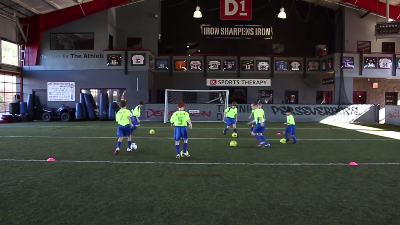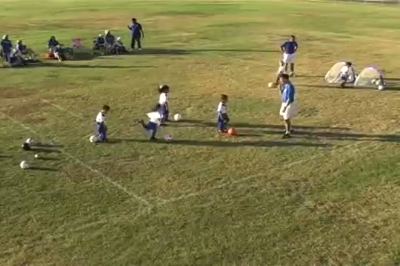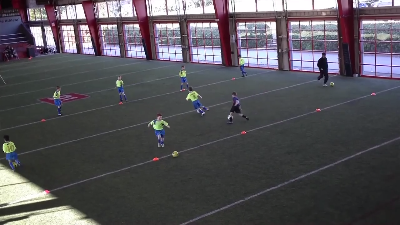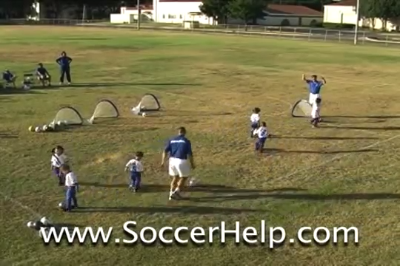
Soccer drills, youth soccer drills and soccer practice games. Soccer drills should be fun, maximize activity and minimize lines. Soccer drills that involve competition produce better results. Soccer drills are not as effective as SoccerHelp Practice Games. Soccer drills allow players to practice at a slow speed. SoccerHelp Practice Games teach players to play fast and under pressure, and they learn more at each practice.
Soccer Drills - Click here for 10 Free Soccer Drills and Practice Games
Soccer Practice - Tips For a Good Soccer Practice Soccer Practice - Things You Need For A Good Soccer Practice Read a Soccer Journal article about why SoccerHelp Practice Games are better than drills. SoccerHelp Premium contains over 70 "Third Generation" Soccer Drills that are Practice Games, including 29 soccer drills for U4 and U6 (age 3, 4 and 5), 45 soccer drills for U8 (age 6 and 7), 52 soccer drills for U10 (age 8 and 9) and 50 soccer drills for U12 (age 10 and 11). Basic versions of nine of those practice games are found below. SoccerHelp Practice Games are superior to soccer drills in 15 ways, as listed below. Our Practice Games are fun and really work. Your team will learn by simply playing the games and you will achieve more in less time. Practice attendance will improve, players will have more enthusiasm and your team will play better and win more games. Our games have been tested by thousands of coaches, including Rec coaches, select and tournament team coaches, adult team coaches, beginning coaches, very experienced coaches, coaches who never played soccer and coaches who played college and professional soccer. In simple terms, we have invented a better "mousetrap". It is a unique, innovative program that quickly achieves results. Our Premium members get more enjoyment from coaching and their players learn more and have more fun. If you have any doubts, read the Testimonials or Coaches Comments. With a 30-day money back guarantee, there is no risk to trying it. If you aren't completely satisfied, just send us an e-mail during the first 30 days and we will give you a full refund with no questions asked. Premium now contains over 500 pages, 1,500 internal links, and a fantastic Search feature that allows you to easily search the entire Premium site to find what you are looking for. It is much easier to use than a book. Over 2,000 coaches have subscribed to Premium.
Many of our games are original. Many of our practice games are original and exclusive to SoccerHelp. They were developed by us, have been tested by thousands of coaches and are available only on SoccerHelp and SoccerHelp Premium. Our games are carefully designed to teach youth how to play soccer and to achieve more in less time. They are "self-teaching" and players learn by simply playing the games. We believe in positive motivation and don't use "knock-out" or elimination games. Our games are designed to meet the 15 standards listed below.
How SoccerHelp Practice Games are developed or adapted from soccer drills. There are thousands of soccer drills on the Internet, but most are not well thought out, efficient, effective or fun. About half of the SoccerHelp Practice Games have been adapted from hundreds of soccer drills and games that we have tested. Less than 5% are selected and those that are selected are then adapted to meet the 15 criteria listed below.
Why SoccerHelp Practice Games are better (the standards we use when developing games):
- They are fun. They keep players more interested, practice attendance is better and players have more enthusiasm. (The challenge is to develop games that are fun but still teach how to play soccer. We don't recommend silly games such as Crab Soccer that are fun but of limited benefit).
- They are designed for Recreational conditions (e.g., limited practice time, players of various skill and stamina, small areas without real goals, varying numbers of players, one coach, etc).
- They maximize activity and minimize lines. More is achieved in less time, players get a better workout and there is less horseplay. We don't use "knock-out" or elimination games that often leave the players who need the most practice standing on the sideline.
- They teach important skills, teamwork and how to play soccer.
- They are "self teaching" and players learn by simply playing the games (the games are truly the teacher).
- They involve competition and pressure (which drills don't) and better prepare players to perform under pressure in "match" conditions and at "game speed". It is one thing to perform an activity without pressure, but it is very different to perform the same activity at "game speed" and under pressure. Players improve more quickly and become better players when they practice at game-speed in match-related conditions. The best way to achieve this is by playing games that are match-related and involve competition and pressure. Our Practice Games also teach players to hustle, win the ball, play aggressively, they get a good work-out and have more fun.
- Set-up is quick and easy.
- They work for almost any number of players and even or odd numbers (e.g., if only 5, 6 or 7 show up they will still work).
- They are written so even beginning coaches can understand them They have worked for beginning coaches and for very experienced coaches; for Rec coaches, travel team coaches and adult team coaches; for coaches who never played soccer and for coaches who played college and professional soccer.
- One coach can manage the game, assistants aren't required.
- They are rated by age group and quality.
- They don't require large fields, lined fields or goals.
- Most of our games can be played indoors.
- For Rec players, we believe in positive motivation and don't believe in punishing a child who has tried their best but lost a practice game. Our games don't make the losers leave the game or run laps.
- For each hour of practice, the objective is 45-50 minutes of effective learning experience versus the 15-30 minutes that is typical for most Rec practices.
Links To Related Topics:
- Tips For Good Practices
- Things You Need For A Good Practice
- How To Teach Soccer Dribbling
- A List Of Over 70 SoccerHelp Premium Practice Games
- Most Important Things To Teach
- Fun and Effective Soccer Practices
- How To Coach Ages 5 & 6 and 7 & 8
- SoccerHelp Home Page
- Table of Contents
Soccer Drills - Free Soccer Drills and Practice Games:
- "Dribble Across A Square" (U-8 & up) * * * * (Definitely try this) This game is the best way to teach dribbling and an excellent warm-up. Playing this in a small square teaches "Control Dribbling", and making the square larger will teach players how to "Breakaway" (how to look for Open Space, accelerate into it, and Speed Dribble). I recommend playing it as a warm-up to start every practice. It will quickly improve your player’s dribbling, shielding, turning, recognition of open space, acceleration and ability to stop and confidence with the ball. They will learn to dribble while looking up. It also helps children's brains learn to process a lot of activity, to use peripheral vision, and to make correct, instinctive decisions and maintain composure when under pressure and in heavy traffic. It is self-teaching and the coach can help the players by giving them “tips” that allow them to improve. You will see definite results within 3 practices, the set-up is easy and it is 100% onball. IMPORTANT: Tell your players that this game is part of their "Warming Up" -- otherwise they may resist it at first (because at first it isn't easy for some players) and they might later get tired of it. BUT, there is no substitute for this game. You are doing your players a favor by having them play it. It will improve their instinctive reactions and dribbling skills in a way no other game can. There is no way dribbling thru cones can teach what this game teaches. Once your players see that it is causing them to improve, they won’t complain about it and they will consider it part of "Warming Up". See "Warm Up Practice Games"
- "Dribble Around Cone & Pass Relay Race" (U-8 and older) * * * * (Definitely try this) This is my favorite game for players U-8 and older. It teaches Aggressive Receiving, passing while running and under pressure, speed dribbling, turning, the importance of first-touch, one-touch control, and teaches receivers to move to the ball and how to receive the ball at game speed and while under pressure. This game is self-teaching and the coach can help the players by giving them "tips" that allow them to improve. Perhaps the most important thing this game can teach is “Aggressive Receiving”. You can read about the benefits of “Aggressive Receiving” on the bottom of the instructions for this game on SoccerHelp. You will see fast results, the set-up is easy and every player is either a dribbler/passer or a receiver.
- "Driving School" (U-6 to U-10) * * * * This game teaches control dribbling, using the bottom of foot to stop the ball, pullbacks, and using outside of right foot and left foot. Easy set-up and 100% onball.
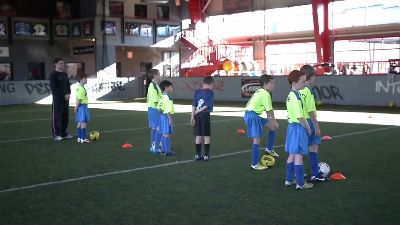
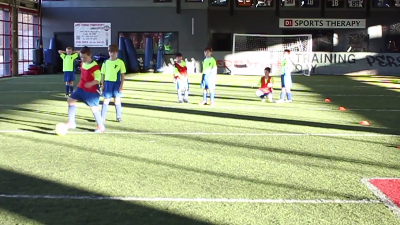
- "Tick Tock" (aka "The Foundation") (All ages) * * * * This is a very simple game that practices fast feet and ball control using inside-of-feet. Very easy set-up and 100% onball.
- "Small Sided Scrimmage Without A Goalie" (U-8 & Up)* * * * This is a better way for most teams to scrimmage. Rec teams should only scrimmage for about 10 minutes of each hour they practice. This game is a good way to evaluate players – you will be able to quickly tell a lot about a player's skills, natural abilities, and where they prefer to play. This game is better than a regular scrimmage in 2 ways: (1). All players learn to defend and play tough defense and block shots, and not rely on the Goalie, and (2). To score, they must work the ball close to the goal and not take long shots, so control, dribbling, passing, and movement off the ball in the Attacking Third are encouraged. This game has the disadvantage of a low ball per player ratio.
- "Chips/Lofted Passes Game" (U-10 & up) * * * * An effective way to practice "lofted passes with backspin". Every player should know how to "loft" the ball for shots, for long "over-the-top" passes & as a way to "clear" the ball. Easy set-up, lots of touches and a game format. 50% onball.
- "Hit The Coach" (U-4 and U-6) * * * * (Definitely try this) My favorite game for U-4 and U-6 players. It’s easy, fun and the kids love it. 100% onball. You can see this on the Coach Doug video clips.
- "Throw-Ins Teaching Game" (U-8 & up) * * * (Try this) This is a quick and effective way to teach or practice throw-ins. If you are a beginning coach, review "How to Teach Throw-Ins" at "Skills" on SoccerHelp.com. This isn't great fun, but it is quick and effective. 50% onball.
- "Kick A Crossed Ball Game" (U-8 & up) * * * * A “crossed ball” is a ball coming from the side. This game is an effective, efficient way to practice timing the run and how to kick a crossed ball, which is not an easy thing to do. It will teach the player to take a short backswing, to keep his head down, eyes on the ball, and to start out by blocking the ball using the inside of the foot.
- "Monster Invasion" (Dribbling & concept of a field, U-4 and U-6) * * * * (Definitely try this) This is a simple, always fun game for U-4 and U-6. Every player has a ball and everyone, including the coach, has fun. 100% onball.
Soccer Practice - Tips For Good Soccer Practices:
- Kids love playing games and keeping score. In practice, try to use Practice Games and not drills. (Click this link to try our 10 free Practice Games)
Everyone should stay active and participate. Avoid lines. Maximize "touches" on the ball. At least 500 touches per practice for each player. Teach proper technique and use games that practice skills or simulate play or "match conditions". Our Practice Games are much better than drills because they involve competition and pressure (which drills don't) and better prepare players to perform under pressure in "match" conditions and at "game speed". It is one thing to perform an activity without pressure, but it is very different to perform the same activity at "game speed" and under pressure. Players improve more quickly and become better players when they practice at game speed in match-related conditions. Run games by keeping time (e.g., so they last 1, 3, or 5 minutes) or by keeping score (e.g., first to 3, 12, etc.). We recommend you by an inexpensive sports watch that has a count-down timer (about $25 at Wal-Mart or Target). Praise hustle, improvement and a good attitude. Measure each player's performance by his or her personal improvement and effort, and not by comparing them to someone else. Try to motivate in a positive way that builds self-esteem. A good Practice Game must be easy and quick to set up by one coach and should be simple to explain and manage. If you are spending too much time on set up or instruction, simplify it. You should be able to play the game in a small area and without special equipment, except for cones or “disk cones”. This is important so you can achieve more in your practices and not waste time. Think about the benefit of being able to achieve 20% or 30% more in each practice. If it's not fun, it's not a good Practice Game. You MUST have at least one ball per player. This is absolutely critical. Ask players to bring extra balls or buy some. DON'T use practice games that eliminate or "knock-out" players. For Recreational players, we believe in positive motivation and we don't believe in punishing a child who has tried their best but lost a practice game. Our Practice Games don't make the losers leave the game or run laps. Nor do we use knock-out or elimination games that leave the players who need the most practice on the sideline. From a practical perspective, punishing players slows down practice and elimination games don't produce as many touches on the ball. Avoid general scrimmaging for more than 10 minutes per hour. In general scrimmages players don't get enough touches on the ball, the weaker players tend to get the fewest touches and bad habits can be reinforced because players tend to do the same things they have always done. If you scrimmage, do so without a goalkeeper and encourage players to work the ball close to the goal before shooting. (Click here for the "Small Sided Scrimmage Without A Goalkeeper" Practice Game). Adopt this philosophy: Keep it simple, keep them active, keep it fun & at least 500 touches per player per practice".
Soccer Practice - Things You Need For A Good Soccer Practice:
- A Ball for Every Player. Ask each child to bring a ball to practice, but buy some extras to bring because some kids will forget. A nylon mesh laundry bag makes a great ball bag. Also, buy a ball pump to keep the balls inflated.
- Small Soccer "Disk" Cones. Disk cones are ideal for marking areas for small sided games. You need 2 disk cones per player (e.g., 30 disk cones for 15 players). Disk cones look like an upside down bowl and come in fluorescent yellow and orange; orange is most visible on brown grass. Consider buying a strap to keep your disk cones on. It is only a few dollars and worth it. As an alternative, you can use strips of brightly colored cloth to mark the areas.
- A Way To Identify "Teams". You can buy practice vests (also called "bibs") for about $6 each, or there are several cheaper ways to identify teams during practice games. One cheap way is to cut the sleeves & bottoms off old t-shirts & use the tops as practice vests; you can spray paint them in different colors to make enough for several teams. Another cheap way is to buy a roll of pink plastic "flagging" at Home Depot ($5.00 in the tool area near the surveying equipment), cut pieces & tie the ends to make a circle that will fit over players heads (around their necks). A third way is to buy a 3-pack of men's "Athletic T-shirts" (about $6.00) in the x-large size. Cut off the top about 3 inches below the bottom of the sleeve & then cut the bottom into 3 cloth circles (just cut it straight across to make the circles). You will get 12 pieces for $6.00. If you need different colors, spray some red or blue paint on them to give a "tie-dyed" look. The bottoms can also be used as field markers.
- Shinguards & Water. Every player should wear shinguards & bring a plastic water bottle with their name on it. I always take extra water because some always forget.
- Assistants. The more the better. Ask parents to help, even if it is just to pick up balls.
- A Whistle. A cheap one will do. This will be hugely helpful in getting attention. Use the whistle to stop & start the practice games described herein.
- An Equipment Bag. To keep your gear in. In it should be some Band-Aids or a small medical kit (about $5). One of the 99¢ instant ice packs is good. (You squeeze these & they get cold. They are at drugstores).
- Do You Need a Goal or a Lined Field? No. None of the SoccerHelp Practice Games require a goal or a lined field. However, a goal or a net backstop is handy if you are practicing shooting.
- A Watch With A Countdown Timer. You can get by without this, but it makes it a lot easier to run timed games. Timex and Casio make models that are available at Target and Wal-Mart for about $25.
How We Rate Practice Games:
The games on SoccerHelp and SoccerHelp Premium were selected from hundreds we have tested. They are the best and all are recommended. However, some are better than others. Those that are especially good for teaching critical skills are given 2, 3 or 4 star ratings & are "Highly Recommended". Four star games either teach a vital skill or concept in a fun & effective way or do an effective job of teaching multiple skills.
Soccer Drills Soccer Drills soccer formations soccer positions soccer rules Remember: Games, not drillsTM & "Keep it simple, keep them active, keep it fun & at least 100 touches per player per practice."
(Dear visitor, ignore these links, they are for the search engines:
Soccer Drills soccer drills soccer drills soccer positions Soccer Rules Soccer Coaching Soccer Positions soccer formations Soccer Rules soccer formations Soccer Practice Youth Soccer Drills Soccer Drills and Youth Soccer Drills )From www.soccerhelp.com
Copyright 1999-2009, David and Kay Huddleston
Want to Re-Print this article or part of it? You are allowed to link back to this article. You may also copy or re-print up to 10 pages from www.soccerhelp.com PROVIDED you don't remove any links or references to SoccerHelp, don't claim that you own the information, and you MUST include www.soccerhelp.com at the top or bottom of the article. To copy our work without crediting us is stealing. We would rather be nice than mean, so please credit www.soccerhelp.com if you copy this.